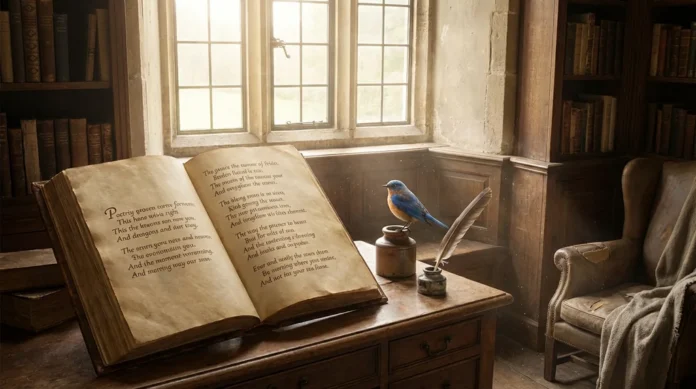
A first poetry reading list should be clear, memorable and varied. This selection brings together ten classic English-language poems that introduce beginners to lyric love poetry, symbolic imagery, nature writing, dramatic music and reflective voice without turning the experience into a school exercise.
Methodology: how this beginner TOP 10 was built
The list favors poems that are widely anthologized, readable in one sitting, distinct in voice and useful for learning how poetry works. The order is editorial rather than statistical: it is not based on votes, sales or a hidden score.
1. “Sonnet 18” — William Shakespeare
Its compact question, seasonal image and controlled turn make it a strong entry point into the English sonnet. Beginners can follow the argument without needing a long historical detour.
2. “The Tyger” — William Blake
Repetition, sound and mystery do most of the work here. The poem is useful for seeing how a simple refrain can create pressure rather than merely repeat an idea.
3. “I Wandered Lonely as a Cloud” — William Wordsworth
This is a natural introduction to Romantic nature poetry: the scene is concrete, the movement is easy to follow, and the closing memory gives the poem its emotional shape.
4. “Hope is the thing with feathers” — Emily Dickinson
Short, compressed and image-driven, it shows how an abstract idea can become vivid through metaphor. It is also friendly to rereading because every line carries weight.
5. “Ozymandias” — Percy Bysshe Shelley
The ruined monument gives beginners a clear story and a deeper idea at the same time: power, pride and time are held inside one unforgettable desert image.
6. “The Road Not Taken” — Robert Frost
Its plain surface makes it accessible, while its reflective voice invites a slower second reading. That tension is exactly why it remains a useful beginner poem.
7. “If—” — Rudyard Kipling
The poem’s direct address and repeated conditions make its structure easy to recognize. It is a good example of rhythm serving persuasion and moral pressure.
8. “The Raven” — Edgar Allan Poe
Longer and darker than the others, it introduces atmosphere, musical repetition and narrative suspense. Readers who enjoy story-driven writing often find it a natural bridge into poetry.
9. “The Lake Isle of Innisfree” — W. B. Yeats
The poem is short, sensory and inward-looking. It teaches how place can become a mental refuge rather than just a setting.
10. “Sonnet 43” — Elizabeth Barrett Browning
This sonnet is direct enough for a first reading and formal enough to reward attention to structure. It closes the list with a love poem built on accumulation and intensity.
A simple way to read the list
Read one poem aloud, mark the image or line that stays with you, then reread only that poem before moving to the next. The goal is not to “finish” poetry, but to notice how a few lines can change pace, sound and feeling.
To keep exploring, browse related Poemopedia reads such as The Key in the Lining, The Chair by the Open Door, The Letter Before the Sea.
Sources
- Poetry Foundation — Sonnet 18
- Poetry Foundation — The Tyger
- Poetry Foundation — I Wandered Lonely as a Cloud
- Poetry Foundation — Hope is the thing with feathers
- Poetry Foundation — Ozymandias
- Poetry Foundation — The Road Not Taken
- Poetry Foundation — If—
- Poetry Foundation — The Raven
- Poetry Foundation — The Lake Isle of Innisfree
- Poetry Foundation — Sonnet 43