There is a distinct, almost universal moment of quiet panic that strikes when we fall deeply in love: the sudden realization that our everyday vocabulary is entirely insufficient. You look at the person sitting across from you, bathed in the soft, golden light of late afternoon, and the standard phrases feel hollow. This linguistic desperation is precisely why, for centuries, human beings have turned to the masters of verse. When we search for the perfect words to capture our racing hearts, we instinctively seek out les plus beaux poèmes d’amour—the most beautiful love poems ever written. These meticulously crafted lines of poetry do more than just rhyme; they distill the overwhelming, technicolor experience of passion into a timeless romantic verses that we can carry in our pockets, whisper in the dark, or write into the margins of a wedding vow.
💡 Key Takeaways
- The greatest romantic poetry balances literary mastery with raw, unfiltered human vulnerability.
- Classic forms like the sonnet use strict structures to contain and amplify intense emotional expression.
- Modern love poems often find profound romance in mundane, everyday moments rather than grand, sweeping gestures.
- Across centuries and languages, poetry remains our most reliable tool for articulating the inexpressible nature of love.
The Timeless Foundations: Curating Les Plus Beaux Poèmes d’Amour

To understand the modern language of romance, we must first look to the bedrock of the poème d’amour classique. The canonical works of the 16th to 19th centuries laid the architectural groundwork for how we articulate devotion. William Shakespeare, perhaps the most famous architect of the English heart, famously defined love by what it is not. In his widely celebrated Sonnet 116, he declares that true affection is an “ever-fixed mark / That looks on tempests and is never shaken.” Shakespeare understood that a genuine déclaration d’amour en vers required acknowledging the storms of life, proving that authentic love does not bend to the scythe of Time.
Moving into the Victorian era, the expression of devotion became deeply personal and intimately biographical. Elizabeth Barrett Browning penned “How Do I Love Thee?” (Sonnet 43) not as a public spectacle, but as a private testament to her future husband, Robert Browning. Published in 1850 as part of “Sonnets from the Portuguese”, this poem famously begins by counting the ways of love, reaching toward the “depth and breadth and height” of the soul. It remains one of the most requested poèmes d’amour célèbres pour un mariage because it perfectly captures the spiritual and everyday dimensions of a lifelong commitment.
Similarly, the Romantic era brought us the nature-infused passion of Lord Byron and Percy Bysshe Shelley. In “She Walks in Beauty,” Byron uses the contrast of starry skies and cloudless climes to praise a woman’s inner and outer grace. These foundational texts established a standard for littérature sentimentale, proving that whether a poem is written in 1609 or 1850, the rhythm of a beating heart remains unchanged.
Bridging the Gap: The Poetics of Long-Distance Yearning
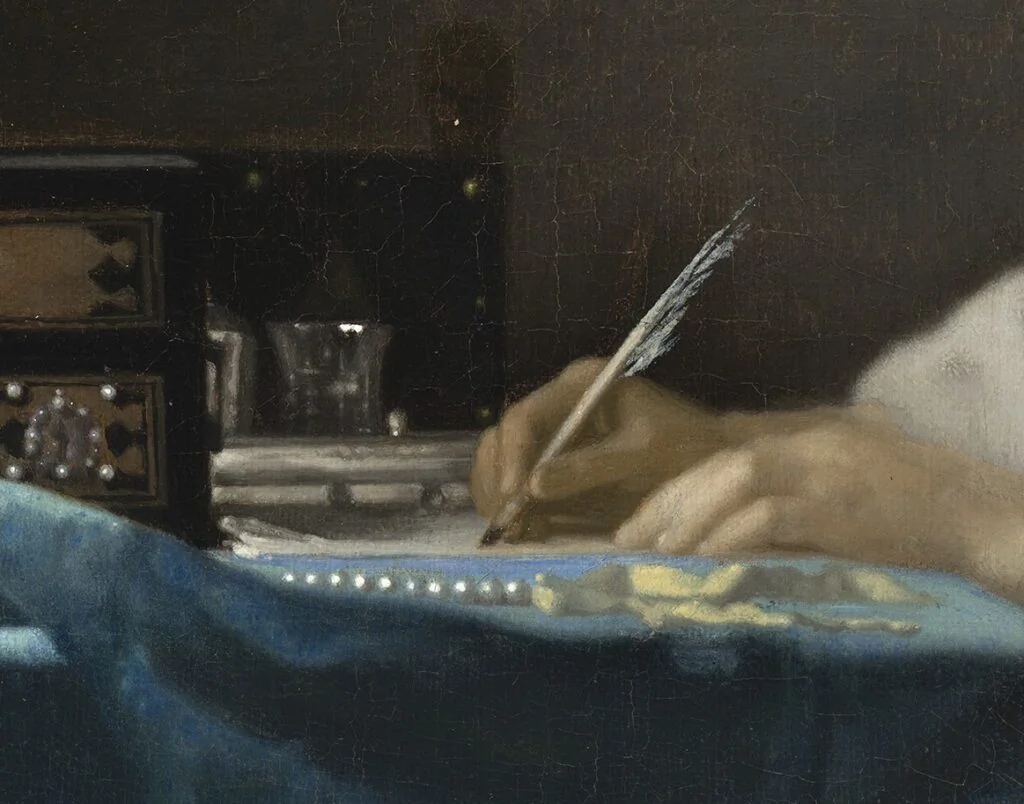
Not all love is characterized by proximity; in fact, some of the most potent poetry is forged in the fires of separation. The agony and exquisite tension of a long distance love have inspired writers to bridge vast physical divides with nothing but ink and paper. Edgar Allan Poe’s “Annabel Lee” explores a bond so fiercely protective that it transcends even death. Poe paints a picture of a love coveted by the angels, demonstrating that true connection cannot be severed by earthly borders or mortality itself.
In a more terrestrial sense, Paul Laurence Dunbar’s “Night of Love” captures the specific, localized ache of missing someone who is sleeping under a different sky. As the narrator sings into the cold air, knowing his beloved is dreaming far away in Paris, the poem becomes a vessel for geographical longing. Modern poets continue this tradition; Donika Kelly’s “Desire Path: Near Equinox” uses the shifting of the seasons and the imagery of Jupiter’s moons to articulate the physical yearning of waiting for a partner’s return. These textes romantiques prove that absence does not diminish love, but rather sharpens it into a fine, piercing point.
Modern Romance and the Stardust of Soulmates

As society evolved, so did the poésie romantique that documented its romances. The 20th century saw a shift away from rigid meter and toward a more intimate, conversational exploration of the soulmate concept. E.E. Cummings revolutionized the love poem with “[i carry your heart with me(i carry it in].” By stripping away conventional capitalization and punctuation, Cummings created a visual and auditory representation of two souls merging into one unbroken entity. It is a poem that speaks directly to the modern desire for a twin flame’s reunion, where boundaries between individuals dissolve entirely.
The Bittersweet Side: Poèmes d’Amour Tristes et Mélancoliques

To speak only of joyous union is to ignore half the spectrum of romantic experience. Often, the most profound verses are born from the ashes of heartbreak. The tradition of poèmes d’amour tristes et mélancoliques offers solace to those navigating the jagged edges of loss. William Butler Yeats masterfully captured the tragedy of unrecognized devotion in “When You Are Old.” He asks his subject to look back on her youth and realize that while many loved her fleeting beauty, only one man loved the “pilgrim soul” within her—a love she ultimately let slip away.
Unrequited love, too, has its champions in the poetic canon. W.H. Auden’s “The More Loving One” presents a stoic, almost defiant approach to unequal affection, arguing that if love cannot be equal, “Let the more loving one be me.” In contemporary spheres, poets like Sophie Robinson explore the grittier, raw realities of a ballad of lost love. In “art in america,” she details the visceral, physical toll of heartbreak in a modern urban setting—drinking bourbon and crying through sheets—while still promising to love the person “gently / the whole length / of my life.” These poems serve as a therapeutic balm, validating the pain of absence while honoring the beauty that the love once held.
The French Connection: Grands Poètes de l’Amour
No exploration of romantic literature is complete without honoring the language historically synonymous with romance itself. When readers ask, quel est le plus beau poème d’amour jamais écrit, many scholars point immediately to the French masters. The realm of poésie française sur les sentiments amoureux is characterized by a unique blend of profound philosophical inquiry and vivid, sensory passion.
Victor Hugo, a titan among the grands poètes de l’amour, often blurred the lines between romantic devotion and deep, existential grief, as seen in his poignant “Demain, dès l’aube.” The French Symbolists, including Paul Verlaine and Charles Baudelaire, pushed the boundaries of métaphores amoureuses, using the intoxicating elements of nature, wine, and twilight to describe the dizzying effects of a lover’s gaze. Moving into the 20th century, Jacques Prévert’s “Alicante” became a modern classic. Prévert proved that a poème d’amour éternel doesn’t require complex vocabulary; the simple imagery of an orange on a table, a dress on a rug, and a fleeting moment of presence can evoke a sentiment so deep it resonates across generations.
The Craft of Passion: Sonnets Romantiques, Vers et Rimes
What makes a love poem endure? According to literary experts, an excellent love poem must balance literary proficiency with honest, unpretentious sentiment. The architecture of a poem—its vers et rimes—acts as a container for the wild, untamed emotion of love. The traditional Sonnet, with its strict 14-line structure and predictable turn (or “volta”), forces the poet to distill their passion into a tight, potent argument. The Villanelle, with its 19 lines and repeating refrains, perfectly mimics the obsessive, looping thoughts of a mind consumed by infatuation.
Even the rhythm of the words plays a physiological role. Iambic pentameter (the da-DUM, da-DUM rhythm favored by Shakespeare) is not merely a stylistic choice; it mirrors the natural, resting cadence of the human heartbeat. When we read these sonnets romantiques aloud, our own bodies align with the physical rhythm of the poet’s passion. Conversely, the advent of free verse, pioneered by writers like Walt Whitman, allowed poets to break the rules entirely. By abandoning fixed rhyme schemes, free verse relies on the natural, breathless rhythms of sincere human speech, creating an anthologie poétique that feels as spontaneous as a whispered confession in the dark.
Finding Magic in the Ordinary: How to Write Your Own Love Poem
If you are inspired to write courts poèmes d’amour pour elle ou lui, the blank page can be intimidating. The greatest trap for an amateur poet is falling into the saccharine, greeting-card clichés of “roses are red.” Expert Deborah Landau suggests that powerful love poems require “skin in the game.” They must address the transience of life, celebrating the vibrant, technicolor life force that surges up despite the passing years and inevitable hardships. A true love poem acknowledges that our time together is finite, making the present moment infinitely more precious.
To capture this, look to the mundane. Wendy Cope’s brilliant poem “The Orange” is a masterclass in modern romance. It describes the simple act of buying a large piece of fruit, sharing it with friends, and doing daily chores. It concludes with the profound realization: “I love you. I’m glad I exist.” You do not need to compare your partner to a summer’s day; instead, focus on the specific, idiosyncratic details. Notice the lift of their heel, the specific scent of their collar, or the way they laugh at a terrible joke. It is in these hyper-specific, ordinary moments that the true magic of romance resides.
In the end, whether you are looking to lire des poèmes d’amour classiques en ligne to comfort a broken heart, or searching for the perfect stanza to read at an altar, the canon of romantic literature stands ready to lend you its voice. The poets of the past and present have done the heavy lifting, wrestling with the complexities of human connection so that we might find our own feelings reflected back to us in perfect clarity. Ultimately, les plus beaux poèmes d’amour remain our most faithful companions, proving that while the people we love may eventually pass into memory, the words we use to immortalize them will echo through eternity.
Key Data & Statistics
- Elizabeth Barrett Browning’s ‘Sonnets from the Portuguese’ was published in 1850 (Source 2).
- The world’s longest love poem, written in 1844, spans 2,900 lines (Source PAA).
- Shakespeare’s Sonnets 18 and 116 were first published in 1609 (Source 1).
- Rita Dove, Pulitzer Prize winner, served as the Poet Laureate of the United States from 1993 to 1995 (Source 2, 6).
- The villanelle poetic form consists of 19 lines organized into five tercets and one final quatrain (Source 1).
Frequently Asked Questions
What is considered the most beautiful love poem ever written?
What makes a good love poem for a wedding?
How do I write a modern love poem without sounding cliché?
Who are some famous French poets known for love poetry?
Sources
Primary Sources
- Love poems for her (poetry examples that will make women swoon) – Creativindie (www.creativindie.com · EN)
- Love Poems — Favorite Classics & Modern Favorites | Medium (medium.com · EN)
- Short love poems for hopeless romantics (www.penguin.co.uk · EN)
- 12 Love Poems for Her That Are the Most Romantic of All Time (www.rd.com · EN)
- 10 Best Love Poems Ever! (www.writersdigest.com · EN)
- Love Poems (www.poetryfoundation.org · EN)
- Queer Love Poems for Whatever You’re Feeling (electricliterature.com · EN)
- Happy Valentine’s Day 2023 Poems, Quotes, Wishes & Messages: 8 romantic Valentine’s Day poems from literature (timesofindia.indiatimes.com · EN)
- 36 Sweet Love Poems (www.familyfriendpoems.com · EN)
- How to Write a Real Love Poem (Without Clichés or Bad Rhymes) (www.oprahdaily.com · EN)